Educator Training • 9 min read • Sep 14, 2026, 8:00:02 AM • Written by: Sarah Sandelius

Go Straight to the Tool. Download the Free High-Quality Checklist Today!
****
Ask five people on a special education team what makes an Individualized Education Program (IEP) good, and you might get five different answers. Ask them to check an IEP against the state's compliance checklist, and everyone agrees, because compliance is objective: the required pieces are either there or they aren't.
Quality is different. It requires judgment: Are the present levels specific enough to explain the student's needs? Do the goals connect to those needs and to grade-level expectations? Are the services and placement decisions likely to provide an educational benefit for this student?
Courts have weighed in on what qualifies as a free and appropriate public education, or FAPE, most notably in the Supreme Court's 2017 Endrew F. decision. But those rulings are fact-specific, and FAPE is a legal floor, not a quality benchmark: it's the minimum a district must provide, not a description of excellence.
Most teams have never developed a shared understanding of what a high-quality IEP looks like, which leads to variation across case managers, schools, or programs. But this is possible to overcome. One of our partners focused on improving IEP quality over two years and saw a 67% gain in IEP quality, alongside significant improvements in statewide ELA scores for students with IEPs. What made the difference wasn't another compliance check: the team built a shared definition of quality, provided ongoing professional learning, and gave teachers consistent feedback they could use right away.

What's the difference between IEP compliance and IEP quality?
Compliance asks whether the required parts of an IEP are there - has the floor been met. Quality asks whether those parts create a useful plan for helping a student make progress. An IEP can be technically complete, with present levels of academic achievement and functional performance (PLAAFP), goals, services, accommodations, and a placement decision, and still be vague or hard for teachers to use.
Here's what that difference looks like:
|
IEP Section |
Too vague |
High-quality |
|
Present Levels |
"Struggles with reading comprehension." |
"Reads grade-level passages with 62% comprehension accuracy, limiting independent access to grade-level science and social studies texts." |
|
Annual Goals |
"Will improve reading skills." |
"By [date], given a grade-level passage, will read aloud at 90 words per minute with 95% accuracy, measured through weekly progress monitoring." |
|
Placement |
"Resource room for all core instruction." |
"General education for math, science, and social studies; a 45-minute weekly reading intervention tied to the specific literacy need identified in the present levels." |
The difference is specificity and intentionality.
Why look at IEP quality more than once a year?
A single annual review tells you what one IEP looks like at one point in time, and it can help you assess whether it appears reasonably calculated to provide FAPE. Looking across several years or a group of students tells you more: whether several case managers are writing vague present levels, whether goals connect to grade-level expectations, whether placement decisions vary appropriately with student need.
Those patterns don't necessarily mean individual teachers are falling short. Often they point to a shared professional learning need or a system that hasn't defined what good looks like.
Download a copy of the High-Quality IEP Checklist
 What does a shared standard for IEP quality look like?
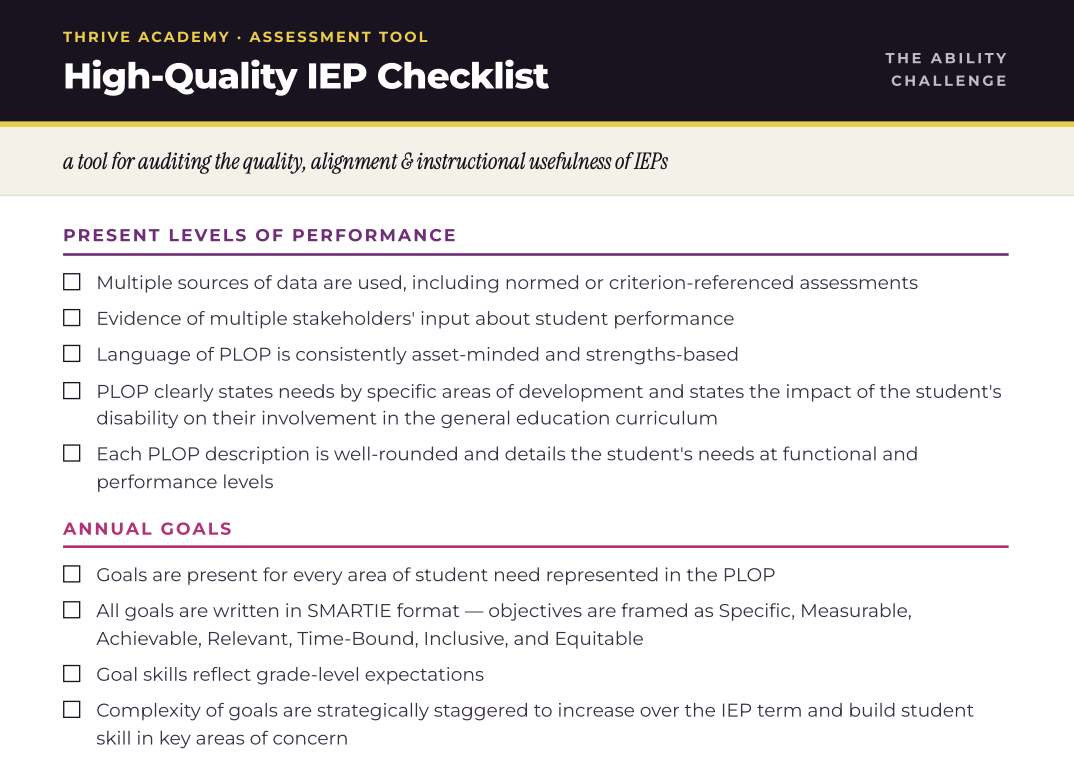
A shared standard gives everyone the same way to think about quality. A high-quality IEP includes present levels grounded in multiple sources of data, specific and measurable SMARTIE (Specific, Measurable, Achievable, Relevant, Time-bound, Inclusive, Equitable) goals, services tied to identified needs, and placement decisions that weigh the benefits of general education against the impact of removing a student from it.
Our High-Quality IEP Checklist covers seven sections of an IEP and is a starting point for teams to talk about quality in their own context. But a checklist alone won't create a shared standard: teams need to examine real examples, discuss what makes one stronger than another, and practice applying the criteria to their own work, especially for present levels. When present levels are vague, everything that follows tends to be vague too.
Put that standard to work throughout the year: spot-check IEPs to see where the team is starting, give feedback early enough to act on, look for patterns across schools and case managers, and track growth over time. None of this requires a complicated system, just consistency.
What can IEP quality tell you about Tier 1 instruction?
An IEP is meant to address the needs that result from a student's disability, on top of strong, universal Tier 1 instruction, not instead of it. When Tier 1 isn't accessible to a student with a disability, the IEP can end up compensating by adding services and support.
If your IEP review identifies any of the following, take a closer look at Tier 1:
- Present levels that mirror general education peers' performance in the same classroom. If data reveals that this is a small- or whole-group issue, then this could be a problem with first instruction rather than a disability related problem.
- Goals that simply reteach core curriculum content (e.g., "will solve 2-digit addition problems") instead of addressing the underlying functional need or access barrier (e.g., "will use a self-monitoring checklist to complete multi-step computation"). Failing to develop goals that address the functional impact of a student’s disability could signal that teams need more support understanding disability-related needs.
- Restrictive placement rates vary by building or by teacher more than by student profile. If Student A would get pulled out in Classroom 1 but would stay in Classroom 2, that's a Tier 1 quality signal, not a student signal. Restrictive placements may be the result of poor classroom management or lack of accessible instruction happening in classrooms.
- Accommodations that function as workarounds for inaccessible materials (e.g., "read aloud" for a student whose actual barrier is attention, not decoding) rather than addressing the student’s documented disability-related needs.
In isolation, these challenges could be viewed as a case manager’s weak IEP writing skills. But if you see patterns across your school or district, you may need to look deeper.
Sometimes the better response is at the system level: stronger Tier 1 supports, clearer expectations for what accessible core instruction looks like, or professional learning that reaches general education teachers, not just special education staff.
How can THRIVE Academy help?
THRIVE Academy is The Ability Challenge's self-paced professional learning library for school and district teams, with courses on IEP quality, specially designed instruction, and special education law, each taking about 60–90 minutes. This fall, Founding Cohort members also get implementation support: a kickoff call, office hours, course completion reporting, and a debrief call.
Learn more about THRIVE Academy
The bottom line
A compliant IEP is required. A high-quality IEP is a choice. The work starts with a shared definition of what good looks like, gets reinforced through regular review and specific feedback, and pays off well beyond any one student's paperwork: it can surface Tier 1 gaps, cut down on repeat mistakes at the next annual review, and build a consistency that no single compliance check can produce on its own.
That's the shift THRIVE Academy is built to support - the shared professional learning that turns a checklist into a habit.
Download a copy of ABC's High-Quality Checklist today!

______________
Frequently Asked Questions
What makes an IEP high-quality, not just compliant? Present levels grounded in data, goals tied to student needs and grade-level expectations, and services connected to those needs.
How often should school leaders look at IEP quality? Regularly, not just at the annual review, so patterns across cases become visible.
How does IEP quality connect to Tier 1 instruction? A weakness that shows up across many IEPs often points to a broader instructional need, not just one case manager.
What is THRIVE Academy? The Ability Challenge's self-paced learning library on IEP quality, specially designed instruction, and special education law, with added implementation support for Founding Cohort members.