
A fourth-grade student with a learning disability has had the same reading fluency goal for three consecutive IEPs. Each year, her team notes she made "some progress." Each year, the goal is renewed with minor wording changes. She is now reading three grade levels behind.
This is not a procedural compliance problem. Her IEPs are technically complete. Her services are documented. Her team has been meeting its procedural obligations year after year. And yet she is falling further behind, not closer to grade level.
For special education leaders, this scenario surfaces an uncomfortable truth: the systems most schools use to review IEPs are designed to check a single point in time. They confirm that a document was completed correctly. They do not tell you whether a student's program is actually working, or whether a pattern of inadequate progress has been quietly accumulating across years.
The Standard the Law Requires
In the 2017 landmark case Endrew F. v. Douglas County School District, the Supreme Court made clear that technical compliance falls short of the legal standard. Chief Justice John Roberts wrote that a student offered an educational program providing “merely more than de minimis progress from year to year can hardly be said to have been offered an education at all.”
Meaningful progress, calibrated to each student's individual circumstances, is what the law requires. An Educational Benefit Review is the tool designed to evaluate whether that standard is being met.

What an Educational Benefit Review Actually Does
An Educational Benefit Review examines three consecutive IEPs alongside supporting documentation: progress reports, evaluation data, report cards, service logs, behavior data, and work samples. The team looks at all of this together, across years, asking a different set of questions than a standard compliance review.
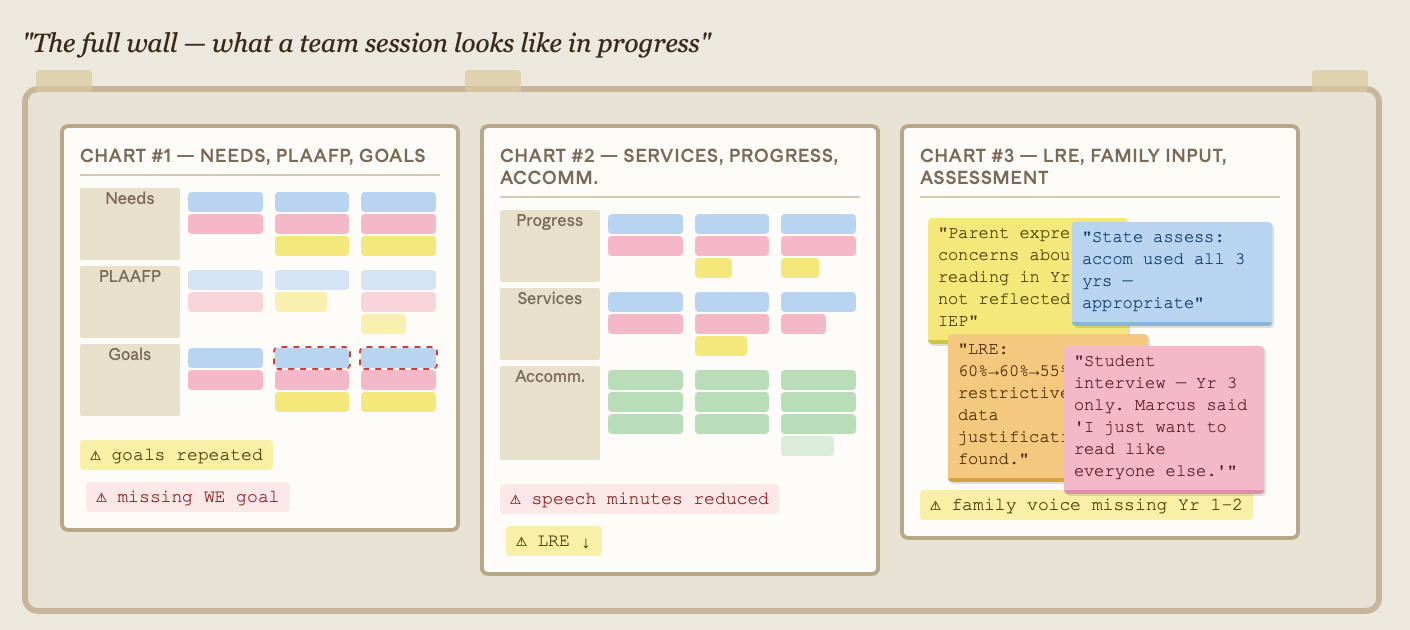
Has this student made meaningful progress over time? Were the goals ambitious enough to move the needle? When progress stalled, did the team change course, or repeat the same plan? Are there needs that have gone unaddressed across multiple IEP cycles?
At The Ability Challenge, we know that when schools have conducted these reviews, they consistently find that the most important signals are longitudinal. A single IEP can look reasonable in isolation. Three IEPs side by side tell a different story.
Three Levels of Value
For an individual student, an Educational Benefit Review brings clarity to teams that sense something is wrong but cannot quite articulate it. It distinguishes between a student who has made genuine gains with appropriate support and one whose plan is on compliance autopilot. That distinction is the foundation for making a real change in what happens next.
By looking at IEPs from across the school or program, patterns emerge that no review of a single IEP can reveal. Are goals being written ambitiously or routinely recycled? Are services aligned to identified needs or defaulting to what has always been done? Is placement being reconsidered as students grow? Is there evidence that teams are actually responding to data, or just documenting it? These are program-level signals, and they tell leaders where the system is working and where it is breaking down before serious compliance or outcome problems are evident.
At the teacher and team level, an Educational Benefit Review surfaces the quality of multiple interconnected systems. When reviews consistently reveal weak present levels, goals disconnected from evaluation data, or insufficient response to lack of progress, those findings point to a professional development need. Leaders who conduct reviews across their programs can use what they learn to focus coaching, design targeted training, and build shared expectations for IEP quality, rather than responding to individual errors after the fact. It can reveal important signals about the quality of collaboration between general and special education teams. Leaders can use an Educational Benefit Review to identify and strengthen weak spots in adult collaboration.

What Comes Next
The review produces a concrete action plan: what will change, who is responsible, by when, and how progress will be tracked. The goal is a clear-eyed understanding of what would need to shift to give this student the ambitious, personalized program the law requires and that every student with a disability deserves.
If you are heading into the summer with questions about whether your program is delivering meaningful progress, that is exactly the right moment to take a closer look.
At The Ability Challenge, we partner with schools and districts to move beyond compliance and build special education systems that produce real outcomes. Download ABC’s Educational Benefit Review Template to get started or book a call with our team to talk through what this process could look like in your context.