In inclusive classrooms, the terms differentiation and specially designed instruction are often used interchangeably. They shouldn’t be.
While both aim to support student learning, they serve different purposes, apply to different groups of students, and carry very different legal and instructional implications. Confusing the two can lead to gaps in services, weak IEP implementation, and students with disabilities not receiving the instruction they are entitled to.
What Is Differentiation?
Differentiation is a general education practice.
It refers to the instructional decisions teachers make to respond to learner variability within a classroom. Teachers differentiate to address differences in readiness, interest, language proficiency, or learning preferences.
Differentiation may include:
- Flexible grouping
- Adjusting the pace of instruction
- Providing multiple ways to access content
- Offering choice in how students demonstrate learning
- Using scaffolds such as graphic organizers or sentence frames
Differentiation is expected for all students. It is part of high-quality, Tier 1 instruction and is not disability-specific.
Importantly, differentiation:
- Is not driven by an IEP
- Is not legally mandated for individual students
- Does not replace special education services
Differentiation and accommodations may help a student participate in classroom learning, but Specially Designed Instruction is what enables a student with a disability to make meaningful progress.
What Is Specially Designed Instruction (SDI)?
Specially Designed Instruction (SDI) is the core of special education under federal law.
The Individuals with Disabilities Education Act (IDEA) explicitly defines special education as specially designed instruction. In other words, in the eyes of the law, SDI is the instructional component of special education.
IDEA defines specially designed instruction as instruction that is:
“Adapted, as appropriate, to the needs of an eligible child… to address the unique needs of the child that result from the child’s disability and to ensure access to the general education curriculum.”
SDI is:
- Individualized
- Disability-related
- IEP-driven
- Legally required
Specially Designed Instruction targets the root causes of a student’s learning challenges, not simply the perceived difficulty of the task.
SDI may involve:
- Explicit, systematic instruction in a targeted skill
- Supplementing the content of the lesson by teaching prerequisite or missing foundational skills
- Altering how instruction is delivered, not just the materials
- Using specialized methodologies or evidence-based interventions
When SDI is implemented with fidelity, it allows students to access grade-level content in inclusive settings in ways that differentiation alone cannot. When instruction is intentionally designed to address disability-related needs, students are more likely to meaningfully participate in grade-level learning alongside peers.
Differences at a Glance
Download this tool by clicking here or on the tool below.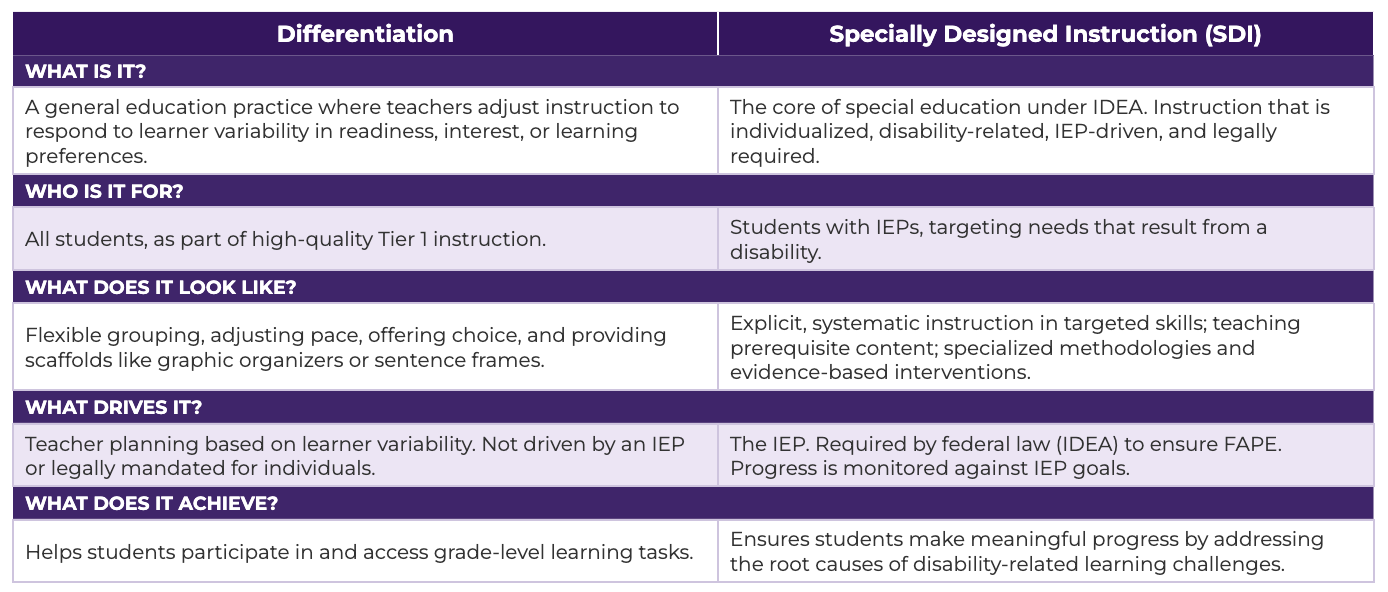

Instructional Example: Fernando
Fernando is a fourth-grade student with a Specific Learning Disability in written expression. His present levels indicate difficulty organizing ideas and constructing complete sentences when writing. Fernando’s IEP includes a goal focused on writing sentences that clearly state a main idea and support it with evidence from the text.
Differentiation |
Specially Designed Instruction |
|
What all students might receive because Fernando’s teacher planned this lesson with learner variability in mind |
What Fernando receives because of his IEP |
These supports help students participate in the grade-level writing task. |
|
In this example, the instruction itself is adapted to address Fernando’s disability related needs. Fernando is not simply supported in completing the assignment. He is taught the specific writing skills he is missing so he can access grade-level writing tasks more independently over time.
Instructional Example Two: Maya
Maya has a Specific Learning Disability in both math calculation (dyscalculia) and math problem solving. Her IEP includes goals related to solving multi-step equations and selecting tools to increase her fluency and accuracy when performing math calculations.
Differentiation |
Specially Designed Instruction |
|
What all students might receive because Maya’s teacher planned this lesson with learner variability in mind |
What Maya receives because of her IEP |
|
|
Maya’s teacher uses differentiation techniques when he designs her lesson for all students. In collaboration with the special education teacher, her Math teacher also adjusts HOW (the methodology) and WHAT (the content) Maya learns to address the needs that stem from her math learning disability.
Why This Distinction Matters
Differentiation is essential to strong instruction, but it is not special education.
Students with disabilities are entitled to instruction that is intentionally designed to address disability-related needs and support progress toward IEP goals. That instruction must be planned, delivered, and monitored with fidelity.
When schools confuse differentiation with SDI, students risk receiving support that helps them participate without helping them progress. When schools get it right, SDI becomes the bridge that makes inclusive classrooms work.
Inclusion is not about where students sit. It is about how instruction is designed so every learner can access, engage with, and make progress in grade-level learning.