
Go straight to the tool: download the free Support Sorter.
Quick answer: An accommodation changes how a student accesses learning while the expectation stays the same. A modification changes what the student is expected to learn. Specially designed instruction changes the teaching itself to address a disability-related need, and under federal law it is the core of special education. Many students need more than one at the same time. A strong IEP names which job each support is doing and how the team will know it's working.
Picture a seventh grader whose Individualized Education Program (IEP) lists eight supports: extra time, a graphic organizer for writing, read-aloud, preferential seating, and four more. Every year her IEP team meets to review the plan and confirms she is still getting all of them. She is. The document is complete.
She still can't organize a paragraph on her own, because no one has taught her how. The graphic organizer gets her through each assignment, so her work looks finished, and the missing skill never comes up.
That gap is easy to miss because supports and instruction look alike on paper. Both sit on the IEP, and both are delivered by adults. They do different jobs, though, and knowing the difference is how leaders make sure students get the instruction they're entitled to.
Our view: every support on an IEP should be able to say which job it is doing, what need it answers, and how the team will know it is working.

What is the difference between accommodations, modifications, and specially designed instruction?
The simplest way to tell them apart is to ask what each one changes.
What is an accommodation?
An accommodation keeps the learning expectation the same and changes the conditions around it: time, setting, format, or tools. Extra time on the same assessment. Text-to-speech for grade-level text. A graphic organizer for the same writing prompt. The student is still responsible for the same content and skills. The accommodation lowers a barrier so the student can show what they know.
What is a modification?
A modification changes the expectation itself: what the student is asked to learn, or how mastery is defined. A substantially simplified text when peers are measured on grade-level comprehension. A writing product scored against reduced criteria. Alternate academic achievement standards. Modifications are appropriate in limited circumstances, and when a team uses one, the IEP should name it clearly. Progress monitoring only works when everyone knows what "progress" means for this student.
What is specially designed instruction?
The Individuals with Disabilities Education Act (IDEA) defines specially designed instruction as adapting the content, methodology, or delivery of instruction to address the needs that result from a student's disability and to ensure access to the general curriculum. Under IDEA, special education is specially designed instruction. Accommodations and modifications support that instruction, but on their own they are not special education.
Here's the difference in practice. Handing a student a graphic organizer because it's on the IEP is an accommodation. Explicitly teaching her how to plan and organize her ideas, because written expression is where her disability gets in the way, and then checking whether that teaching is working, is specially designed instruction.
A student can need all three. Problems start when all three get listed on an IEP as one pile of "support," and the team ends up measuring whether adults delivered it instead of whether the student learned.
(Teams often blur a related pair, too. See our post on differentiation vs. specially designed instruction.)
Can the same support be an accommodation and a modification?
Yes, and it's the distinction that trips up even experienced teams. What makes a support an accommodation or a modification is what it does in relation to the learning target, not the tool itself.
A calculator is an accommodation on a science test that measures whether a student can apply a formula. On a test of computation fluency, the same calculator is a modification, because it removes components of the skill being measured. Read-aloud works the same way. On a history test, it gives a student with a decoding disability access to grade-level content. On a decoding assessment, it changes what's being tested.
So the question to ask of any support is simple: what is the learning target (or what is the IEP goal, for that matter), and does this support keep it intact?
Download the free Support Sorter: two questions to sort every support on an IEP.
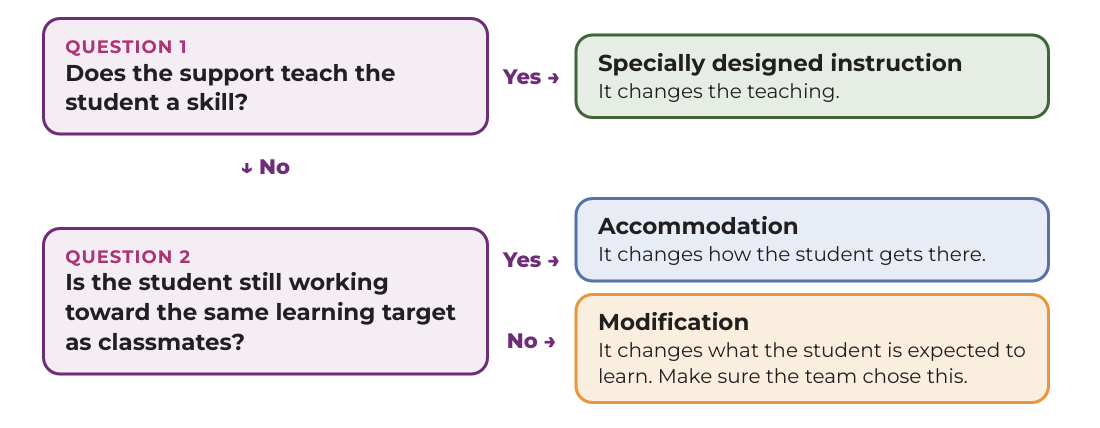
Why the difference matters: is it access or is it instruction?
Accommodations and modifications are about access: how a student reaches the learning, and what learning she's expected to reach. Specially designed instruction is about teaching. Students with disabilities typically need both. When teams aren't clear about the difference, students tend to lose the teaching.
When access stands in for instruction
When a student has a long list of accommodations, a team can feel it has "already provided support" even if no one has changed the teaching. The seventh grader has her graphic organizer. What she doesn't have is anyone teaching her to plan a paragraph without it.
Progress data often hides this. Take a student with a math disability who uses a calculator in class. That may be exactly right, because the calculator gives her access to grade-level problem solving. The trouble comes when the calculator is the whole plan. Her classwork looks fine, so nobody notices that her computation skills aren't being taught. A stronger IEP (and its effective implementation) does both at once: the calculator for access during grade-level work, and specially designed instruction to build computation, measured against a goal.
This is where we'd push leaders hardest. In its 2017 Endrew F. decision, the Supreme Court held that a student's educational program must be "appropriately ambitious" in light of her circumstances. An IEP full of accommodations and thin on instruction may be complete on paper, but it's hard to call ambitious. Accommodations give students access to learning. Specially designed instruction is how they grow into it.
When access quietly lowers the target
The second risk runs the other way. An accommodation can drift into a lower expectation without anyone deciding it should. A teacher cuts an assignment in half for a student with slow processing speed. The intent is kind, but the student now does half the content. Extended time, or breaking the assignment into chunks so she reaches every part, would have kept the content expectation in place. Repeated across classes and years, these small cuts add up to a thinner curriculum, and in many states a heavily modified course of study can affect a student's diploma options.
How can school leaders check whether an IEP's supports are doing their jobs?
Case managers usually know these definitions. The gap tends to show up everywhere else: in the general education teachers who deliver supports every day, the paraprofessionals who hand out tools, and the administrators who sit in IEP meetings as the LEA representative. Principals and Chief Academic Officers need to set the expectation that every adult who works with a student with an IEP knows which job each support is doing.
The most useful habit is tracing each support back to the need it serves:
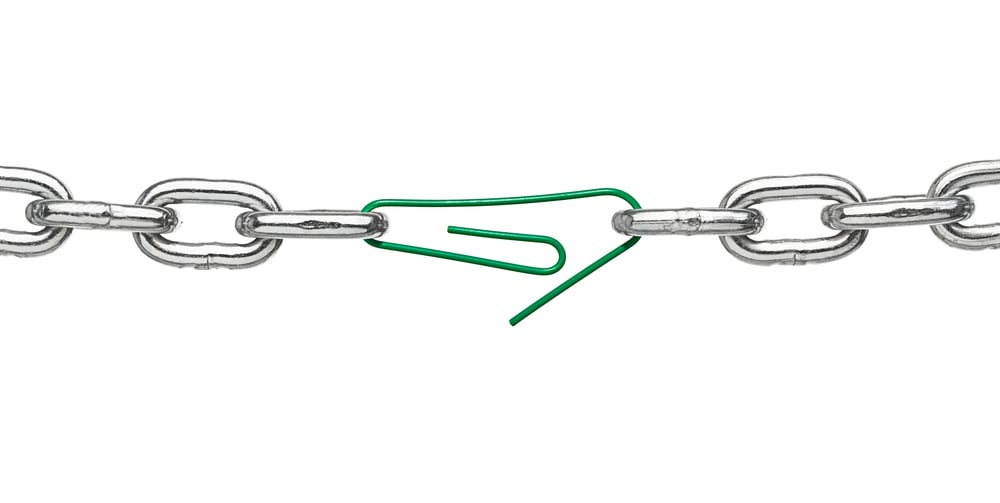
Need in the present levels → learning expectation → accommodation or modification → specially designed instruction → evidence of impact
When the chain breaks, the break tells you where to look:
- An accommodation with no need behind it is usually habit.
- A modification that no one clearly defined makes progress data hard to read.
- A need with no instruction attached means the student may have access but isn't being taught.
- A support with no evidence of impact will be hard to defend at the next annual review.
A special education leader can run this with her team in fifteen minutes. Pull one current IEP at a team meeting and sort every support with the two questions in our free Support Sorter. Principals can do the same thing on a walkthrough: pick one student's IEP, watch how the supports show up in class, and ask the teacher what each one is for. (If your IEPs don't describe needs clearly enough to start the chain, our present levels checklist is a good place to begin.)
The last link, evidence of impact, is also where teams decide what comes next for each support: does it remain necessary, need to change, or can it be faded? Independence doesn't always mean a support goes away. For some students, using the right accommodation on their own is independence. For others, a support has done its job and can step back. Either way, the decision should come from evidence, not from last year's list. (For more on stepping back adult support, see The Support Trap.)
How can THRIVE Academy help?
These distinctions stick when a whole staff learns them together. THRIVE Academy, The Ability Challenge's self-paced professional learning library, offers 60- to 90-minute courses on IEP quality, specially designed instruction, and special education law. Institutional access covers your entire staff, and Founding Cohort members get added implementation support through November 30.
Learn more about THRIVE Academy
Back to the seventh grader
Picture her IEP a year from now. The list of supports might be shorter, or it might be the same length, but every item has a reason. She still uses the graphic organizer on long assignments, and she's also been taught to plan a paragraph without it. Her team can say which supports give her access, which instruction is building her skills, and how they know it's working.
Students deserve IEPs that know the difference.
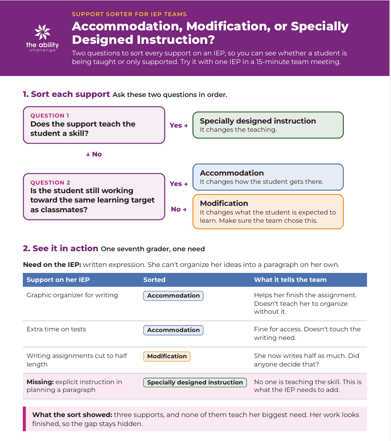
Download the free Support Sorter
Try it with one IEP in a 15-minute team meeting.

___
Frequently Asked Questions
What is the difference between an accommodation and a modification?
An accommodation changes how a student learns or shows learning, such as time, format, setting, or tools, while the expectation stays the same. A modification changes the expectation itself, such as what content the student learns or how mastery is measured.
Is specially designed instruction the same as an accommodation?
No. Specially designed instruction adapts the content, methodology, or delivery of teaching to address a disability-related need. Accommodations reduce barriers to access but don't teach new skills. Many students need both, for example, a calculator for grade-level problem solving alongside instruction in computation.
Can the same support be an accommodation and a modification?
Yes. A calculator is an accommodation on a science test and a modification on a test of computation fluency. What matters is whether the support keeps the learning target intact.
Should accommodations always be faded over time?
No. For some students, using the right accommodation independently is the goal. At least at every annual review, teams should use evidence to decide whether each support remains necessary, needs to change, or can be faded.
Sources: Individuals with Disabilities Education Act regulations, 34 CFR §300.39; Endrew F. v. Douglas County School District RE-1, 580 U.S. 386 (2017).
